Visuals
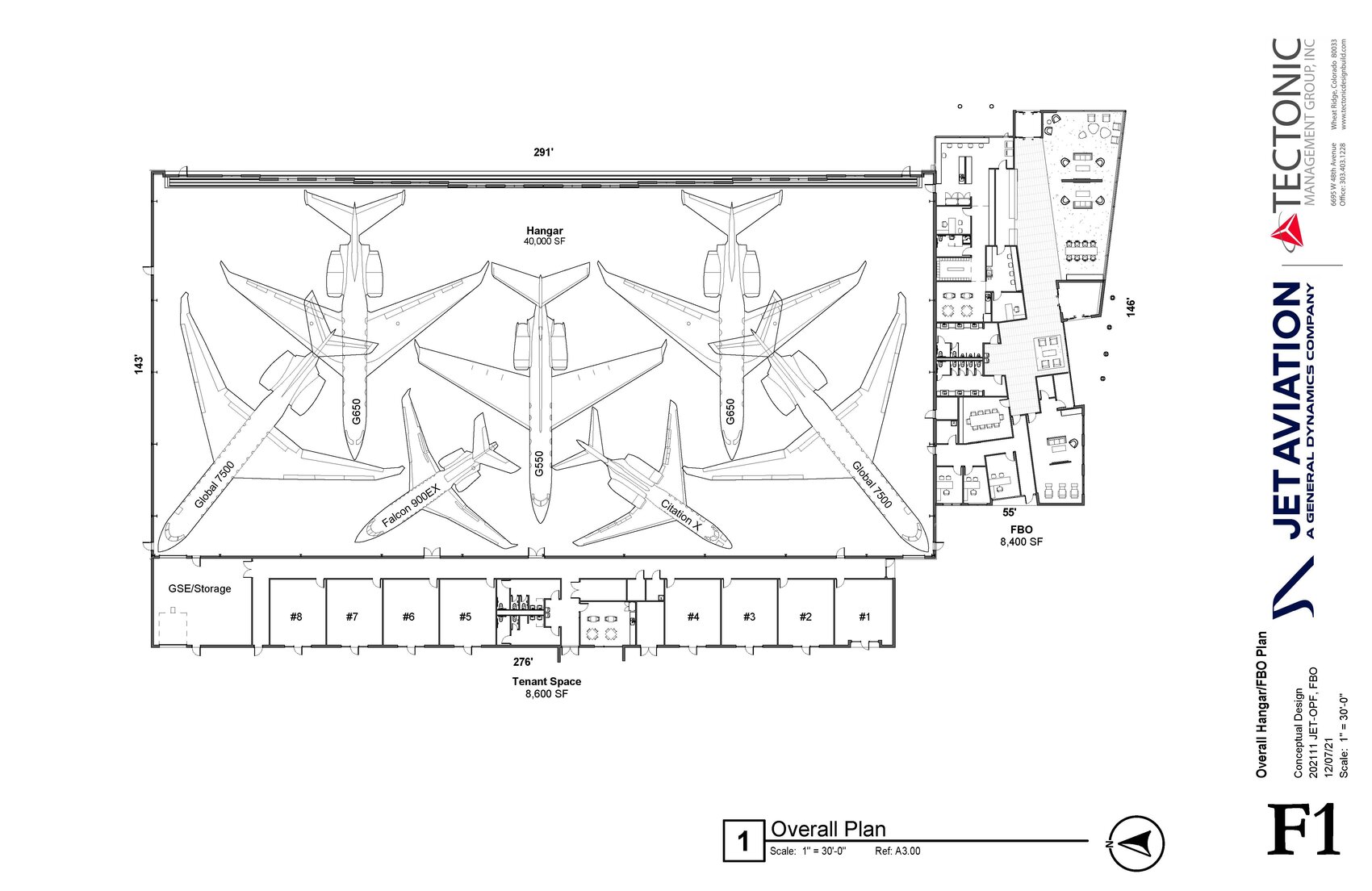
The FBO site plan
When a global aviation leader chooses Miami-Dade for its next fixed-base operation, the ripple runs far beyond the runway. BusinessFlare® quantified what a new FBO would mean for the county's jobs, earnings, and public revenue.
Jet Aviation — founded in Basel, Switzerland in 1967 and now a General Dynamics company operating in 50 locations worldwide — set out to build and operate a new fixed-base operator (FBO) facility at Miami Opa-Locka Executive Airport. The Phase 1 scope pairs a 40,000-square-foot hangar with an 8,400-square-foot FBO terminal, aircraft ramp, a Customs and Border Patrol facility, and dedicated tenant space, positioning the site as a premier gateway for business and private aviation in South Florida.
To support the company's application to Miami-Dade County's General Obligation Bond Program 124 (the Economic Development Fund), BusinessFlare® prepared an independent economic and fiscal impact assessment. Using established input-output methodology, the analysis translated construction budgets and operating projections into the jobs, earnings, industry activity, and county revenue the investment would generate.
A $34 million private investment, seeded in part by a $5 million General Obligation Bond request, was projected to generate $53.7 million in economic impact across Miami-Dade County during construction alone — supporting roughly 316 jobs — while its ongoing operations would drive tens of millions more in annual economic activity and an estimated $20 million in new county revenue over twenty years.
Four lenses on how a single aviation facility reshapes a regional economy.
Phase 1 establishes a modern FBO campus at Miami Opa-Locka Executive Airport, with additional hangars planned once the first phase is complete.
The hard and soft costs of construction were run through an input-output model to estimate jobs, earnings, and total output generated across the county.
Beyond on-site payroll, the facility's leasing, business activity, and worker and customer spending sustain a broader web of jobs and output year after year.
The assessment projected the direct revenue Miami-Dade County would collect from the facility through aviation and tax mechanisms over its first two decades.